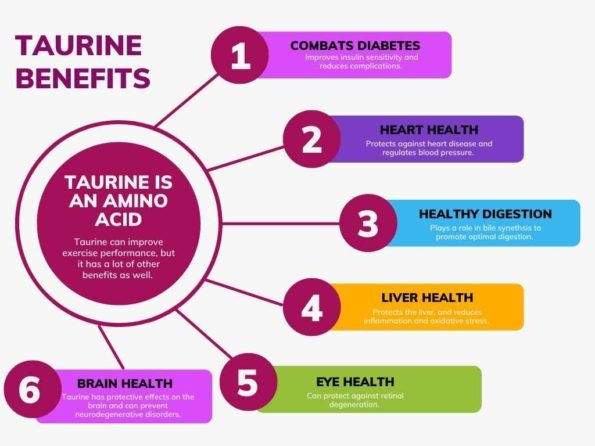



Taurine is an amino acid that has a few important roles in your body, including supporting immune health and nervous system function. Most of the time, your body produces enough taurine on its own, but adding in your smoothies or taking supplements can also help you meet your taurine needs.
Taurine is a naturally occurring sulfur-containing amino acid that is found abundantly in the brain, heart, eyes, and muscles. It plays important roles in various bodily functions, including supporting nerve growth and maintaining cardiovascular health. Taurine is not used to build proteins but is crucial for many physiological processes. It can be obtained from dietary sources such as meat, fish, and eggs, and is often added to energy drinks and nutritional supplements.
-
The main roles of Taurine in your body are:
Maintaining proper hydration and electrolyte balance in your cells
Forming bile salts, which play an important role in digestion
Regulating minerals such as calcium within your cells
Supporting the general function of your central nervous system and eyes
Regulating immune system health and antioxidant function
Taurine deficiency has been shown to cause eye damage, chronic liver disease, muscle weakening, and an increased risk of developing diabetes
May fight diabetes
Taurine’s antioxidant and anti-inflammatory properties may enhance insulin sensitivity, thereby reducing the risk of type 2 diabetes or improving blood sugar management in those with the condition.
Indeed, one study found that people with diabetes have a 25% lower concentration of Taurine than those without diabetes. This suggests that Taurine may have a role in diabetes management.
Although current research on the effects of taurine supplements for diabetes management in humans is limited, a 2018 review suggests that the supplements could be a good therapeutic option for improving blood sugar management in people with diabetes.
The same review also suggests that Taurine could have protective effects against diabetes-related complications such as nerve damage, kidney damage, and heart disease
May improve heart health
Taurine supplements have been shown to regulate blood pressure and improve heart function and blood fat levels in people with heart conditions such as heart failure. At high levels, it may even protect against heart disease.
Research suggests a link between higher Taurine levels and reduced cholesterol, lower blood pressure levels, and significantly lower rates of death from heart disease.
In one study, people with heart failure took 500 mg of taurine three times daily for 2 weeks.
They experienced significant reductions in levels of total cholesterol, triglycerides, and C-reactive protein (CRP) — an inflammatory biomarker — both before and after exercise, compared with those who took a placebo.
In a 12-week study in people with high-normal blood pressure, taking 1.6 grams of taurine per day reduced systolic blood pressure (the top number) by 7.2 mmHg and diastolic blood pressure (the bottom number) by 4.7 mmHg compared with placebo.
Taurine may help reduce high blood pressure by decreasing the resistance of blood flow in your blood vessel walls and by improving the efficiency of skeletal and heart muscle contractions.
May boost exercise performance
Because of its ability to enhance muscle contraction and delay muscle fatigue, Taurine may benefit athletic performance.
What’s more, Taurine may increase fat burning during exercise to better fuel your performance.
A review of 19 studies assessing the effects of Taurine on athletic performance noted several benefits, including:
Increased oxygen uptake by the body
Increased time to fatigue
Reduced muscle damage
Improved recovery times
Improved strength and power
The review authors suggest that an effective dose to achieve these benefits is 1–3 grams taken 1–3 hours before your workout for at least 6–21 days
Other health benefits
Other potential benefits of taking taurine supplements include:
May benefit eye health. Taurine’s antioxidant effects may help combat the oxidative stress associated with retinal degenerative diseases such as age-related macular degeneration.
May benefit hearing. Taurine may prevent the hair cells within the ear from becoming damaged, which is a key contributor to hearing loss.
May offer neuroprotective effects. The anti-inflammatory effects of taurine may reduce inflammation within the brain and combat neurodegenerative conditions such as Alzheimer’s disease.
May support liver health. Taurine may have protective effects against chronic and acute liver injury.
How to supplement
The most common dosage range for taurine is 500–3,000 mg per day.
However, keep in mind that an EFSA report from 2012 suggests that up to 6,000 daily is safe, demonstrating its strong safety profile.
While some studies may use a higher dose for short periods, sticking to 3,000 mg per day will help you maximize the benefits while staying within a safe range.
The easiest and most cost-effective way to reach this dosage is through powder or capsule supplements. Most capsule supplements contain 500–1,000 mg per serving, while powdered taurine can have 1,000–2,000 mg per serving.
You can request at MXNUTRISHOP your TAURINE ADD-IN for your favorite smoothie or buy the supplement in the store!
One serving (1 spoon 3g): Taurine (Free-Form) 3,000 mg